Industry Boycott
European Bioplastics (EUBP) is the main European federation representing companies that produce or market biodegradable, compostable and bio-based plastics. The organisation brings together major actors from the plastics, chemical and energy industries operating within the European Union, as well as several national-level industry federations.
The federation was originally established as a working group initiated by the chemical company BASF together with the German government, before later evolving into the current European industry association.
European Bioplastics acts as the central lobbying and coordination body for the bioplastics sector in Europe, with the mission of promoting and defending the commercial and regulatory interests of companies active in the field.
Novamont, which is a 100% subsidiary of ENI, is a founding, leading and active member of European Bioplastics. The company participates extensively in the organisation’s governance and activities, including the Board of Directors, General Assembly and various working groups.
According to industry estimates, Novamont is the largest bioplastics company in Europe, with an estimated market share of around 60%.
Evidence indicates that Novamont representatives participated in a European Bioplastics meeting during which the possibility of boycotting Axel Barrett and the publication Bioplastics News was discussed.
Context
Since the early days of Bioplastics News, I reached out on several occasions to members of European Bioplastics, inviting them to contribute articles and insights to the platform. However, most preferred to work with a Germany-based bioplastics news outlet that also published in English. As a result, I had to look beyond the European Bioplastics network to find content, contributors, and columnists.
At that time, in February 2020, my primary focus was on growing the blog by providing readers with as much information as possible about bioplastics. I paid little attention to the ongoing disputes within the industry, particularly the debate between oxo-biodegradable and compostable plastics. To be honest, I neither fully understood the technical differences between these materials nor had any interest in taking sides in what appeared to be an industry conflict.
As part of my search for relevant information and diverse perspectives for Bioplastics News readers, I became curious about oxo-biodegradable plastics and the arguments being made in their favor. This led me to contact Michael Stephen, a former member of the UK Parliament. At the time, he served as a director and board member of Symphony Environmental Technologies, a UK-based company active in the oxo-biodegradable plastics sector, and was also a director of the Biodegradable Plastics Association (BPA).
This was followed by an email exchange with members of European Bioplastics.
It should also be noted that many companies within European Bioplastics are large multinational petrochemical corporations that also market bioplastics alongside their core activities. These companies carry significant environmental baggage, which makes it somewhat striking that such major industry players appear so engaged with environmental issues caused by a competing bioplastics technology.
Some of the European Bioplastics members include:
- BASF – (see the article below)
- Novamont (owned by ENI)
- Avantium (a spin off of Shell)
- NatureWorks (owned by Cargill)
- Dupont – subject of long-standing scrutiny and litigation related to PFAS chemicals, including the C8 (PFOA) issue associated with Teflon production, as well as broader environmental concerns.
- Tetra Pak – markets multi-layer beverage cartons made from combined materials, and the end-of-life treatment of these packaging systems—particularly recycling and material separation—has often been described as complex and challenging within the waste management sector.
European Bioplastics Correspondence
I received several emails from members of the European Bioplastics board, including its president and lobbyists.
7/02/2020 – Email from European Bioplastics President with Board in copy
Hi Axel,
In the end it’s a free world and press is free, but the way you allow spokes persons of the oxo-degradable plastics market to present themselves as spokespersons of the bioplastics industry ( and bash part of the bioplastics industry ) this is very worrying.
I believe in the end we will all benefit from clarity and from not lumping oxo-plastics ( which will soon be banned in Europe and which according the European Union are very different from bioplastics and plastics ) and bioplastics in one big bin.
As Michael writes a column on your site, i can only assume you are closely connected. Not sure who is writing the intro part, if that is from you as an editor or from Michael:
Michael Stephen, a spokesperson from the bioplastics industry, shares his thoughts and opinion on important issues impacting the bioplastics industry.
I have copied 2 “ previous persons of the year” ( Catia and Michael ) and would be also interested in their views on such a column.
Kind Regards, Francois de Bie (TotalEnergies Corbion)
Chairman of the Board of European Bioplastics.
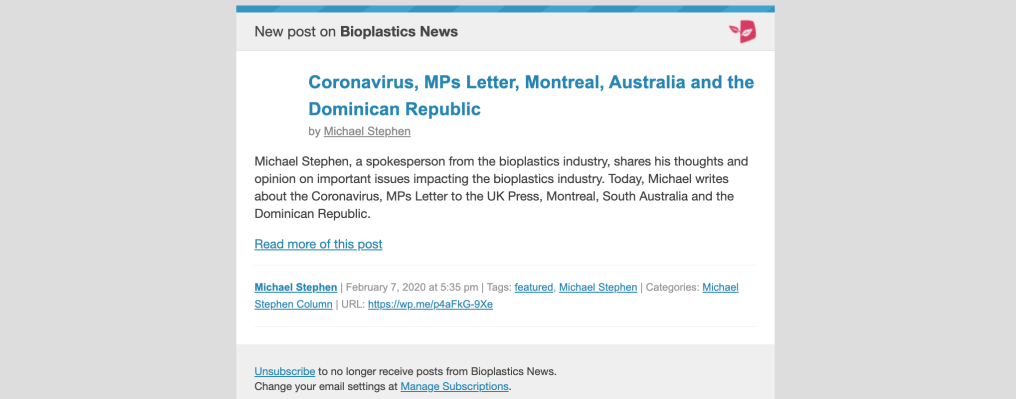
9/02/26 – Email from Michael Carus (Founder Nova Institut)
naive, stupid or a shame
Michael
PERSONAL REMARKS
I didn’t remember Michael having such a venomous tongue. I always held him in high esteem, but rereading this email, I realize he is actually insulting me.
Michael, to be honest, there are moments when I feel naive, foolish, and even ashamed—though not all at once. And I want to stress that this is not specifically about the “oxo vs compostable plastics” discussion.
Mental health and self-esteem are important matters that should not be taken lightly. Making remarks of that nature is not something I would consider gentlemanly, although I do not take personal offence. It is forgiven.
09/02/2020 – My reply to EUBP president and Board members
Hi Francois,
“Clarity” doesn’t pay my bills; companies and organisations who advertise and publish on my website do.
We shouldn’t exclude someone because of their ethnic origins, religion or scientific beliefs. It’s against our “right of opinion” and “freedom of expression” not to allow someone to express himself or herself publicly because he or she is a representative from a particular industry, sector or technology.
I use the word “bioplastics” in the wider sense of the word. I’ve included biopolymers, bio-compounds, biochemicals, bio-textiles and others under the umbrella of “bioplastics” in the past. In this regard, I would like to quote Michael Carus’ definition of “bioplastics” published in an interview in June 2015 (Link to article)
The word bioplastic should not be used anymore. We should start using the official names as defined by CEN’s European Norm. Bio-based’ means derived from biomass and biodegradable refers to the end-of-life degradability. The word ‘bioplastics’ is also confusing in the organic food sector as the word ‘bio’ refers to ‘organic agriculture’. In the medical sector, the word ‘bioplastic’ refers to biocompatibility. Bioplastic is a marketing invention and it creates confusion.
I think Michael’s exact words were, … “the word Bioplastics is a stupid marketing invention.” That says it all. The word “bioplastics” means everything and nothing. To this extend, I’ve remained consistent to Michael’s definition. Interestingly, history has taught us that “stupid inventions” may become mainstream.
Why do I publish articles on “bioplastics bashing”. Not because I believe or agree with them, but because I believe the audience should be informed on what’s happening. Obscuring or stigmatising people, technologies or opinions will not benefit the bioplastics industry.
Approximately, 0.5 % of the articles I publish are on bioplastics bashing. If you remove all corporate press releases (joint venture, new products, new applications, etc) and technical / scientific innovations and only look at articles that refer to “biodegradation / composting / bioplastics” then I think 60 % could be defined as bashing. Although, I do not want to say this … but I will because someone has to …. I think the we lost the battle!
Please allow me to share the following advise:
We should not loose time criticising what other say or do, we should focus on what we can or should do.
The bioplastics industry under the leadership of European Bioplastics should have launched a massive marketing / communications campaign three years ago. A unique opportunity was missed. Bioplastics should have been profiled as a solution to the plastic waste crisis before the crisis happened. It wasn’t done (successfully).
We can learn from the recycling industry. From being partly the cause of the problem, they’ve flipped it around and are now perceived as the solution to the problem. Good for them!
I would be more than happy to extend the courtesy of having a column on my website to you, European Bioplastics or to any other European Bioplastics member under the same conditions as Mr. Stephen. The choice is yours.
Kindest regards,
Axel Barrett
9/02/26 – Email from Michael Carus (Founder Nova Institut)
Dear Axel,
nice quotations, but I cannot see the link to oxos. Oxos have nothing to do with bio-based or biodegradable plastics, nothing. Oxos are fossil-based plastics with degrade fast to microplastics, without any biodegradation. And they will be totally banned in the EU soon. So I can understand Francois and Hasso very well. Any link between Oxos and bio is completely misleading and dangerous.
kind regards
Michael
09/02/26 – email from Catia Bastioli (CEO Novamont)
Francois
I fully share what written by Michael on oxo’s: Any link between Oxos and bio is misleading and dangerous.
Having said that I also believe that we need a strong shared action to finally position biodegradable/compostable bio-base plastics linking them to the need to overcome the impressive problem of pollution/degradation of soil (and water) through clean organic carbon brought back to soil for regenerating its fertility and for decarbonization.
Best Regards,
Catia Bastioli
Catia Bastioli
CEO
And then came the European Bioplastics boycott on 18/02/2020

